
Use case
Use case · AI in the ERP
An AI agent that answers with your ERP's real data
We use it in our own ERP: ask in plain language, get the right figure, and keep control of permissions and audit.
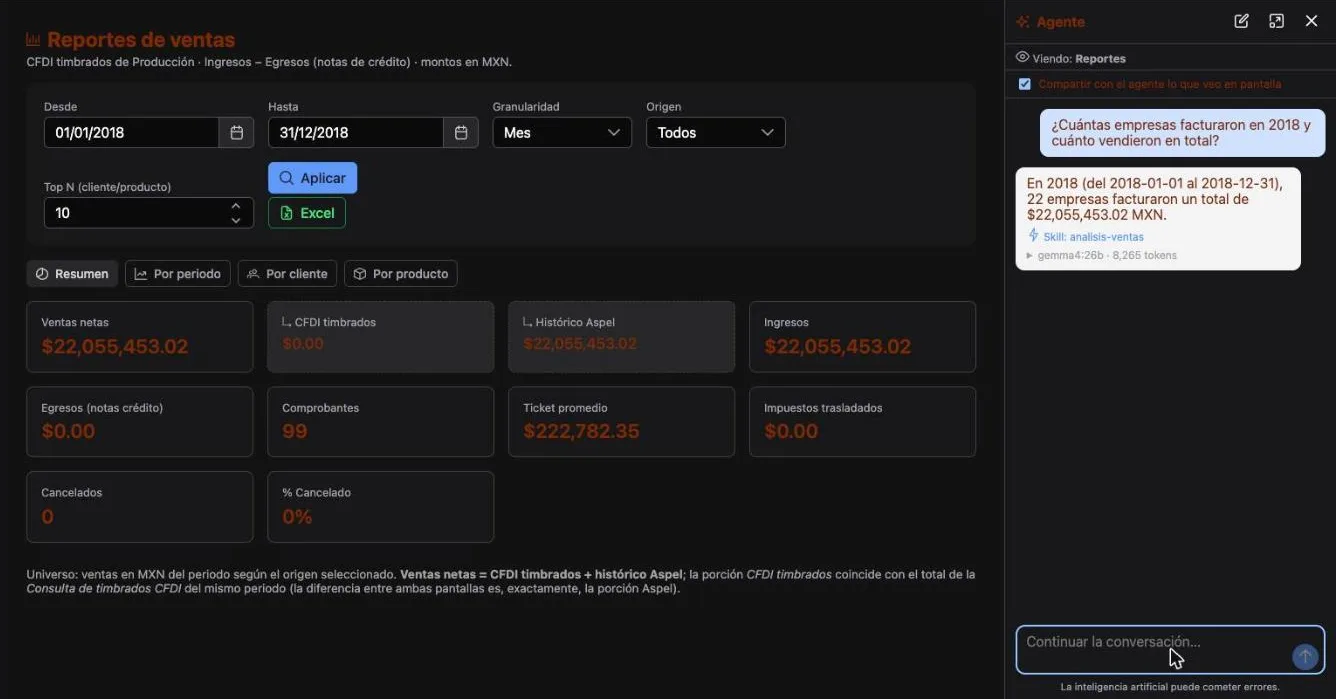
“How many companies were invoiced in 2018?”
Answered in seconds, using the same logic as our official reports.
Why it matters
A first-hand, verifiable case
A case of our own
Siscon uses it in its own operation; we don't just recommend it.
No direct database access
The model only reaches controlled, read-only tools.
Replicable
The pattern (tools + skills + permissions + audit) can be taken to other systems.
Data sovereignty
The model is interchangeable: a cloud service or an open model inside your network.
What you get
- Natural-language questions from any screen
- Respects each user's permissions
- Read-only: it does not modify your information
- Every query is audited, with transparent cost
- Works with the model you choose
Challenge, solution and result
From question to the right figure
Challenge
Business data lives in the ERP, but getting a specific answer means knowing the right screen, applying filters and sometimes exporting to Excel.
Solution
An AI agent inside the ERP that turns natural-language questions into controlled queries. Every query goes through tools that reuse the logic of the existing reports, so the agent's figure matches the official screen.
Result
- Answers in seconds to questions that used to require browsing reports or asking for help.
- Zero direct model access to the database; every tool requires a specific user permission.
- Every query is audited: user, model, tokens, tools and skills.
How it works
Five steps, fully traceable
1. The user asks
They type in plain language from the side panel, on any screen.
2. The agent picks the skill
If the question falls in an area (for example, sales), it loads that area's guide: when to use each tool and which rules to follow.
3. It queries with tools
Only the ones the user is allowed to use. Without permission, they are not even offered to the model.
4. It answers with traceability
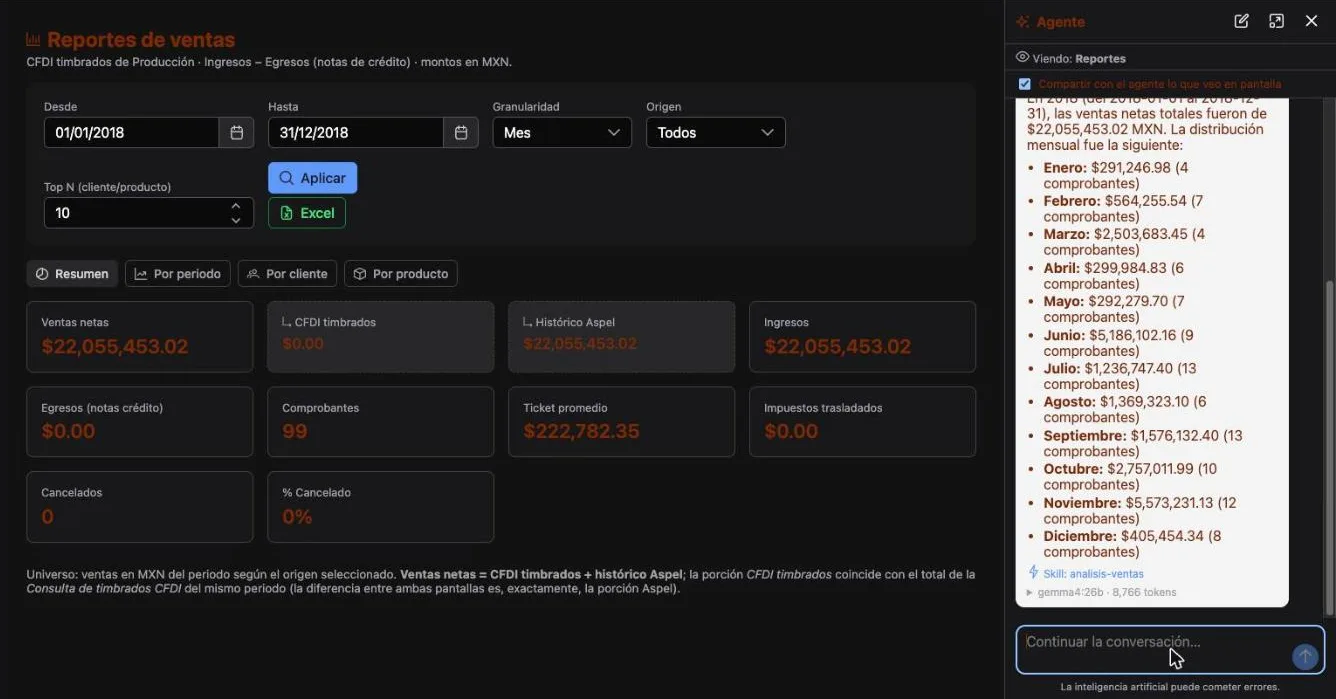
It gives the figure, states the period and source consulted, and shows which skill and tools it used.
5. It is audited
Query metrics are recorded: user, model, tokens, tools and skills.
Real demo
Real data, masked
Two screenshots with masked data, using the open model gemma4:26b running locally.
Security and governance
Control by design
Inherited permissions and isolation
The agent never sees more than the user does, and its tools respect the ERP's multi-organization isolation.
Read-only
At this stage the agent does not modify information.
Versioned skills
Domain knowledge lives in reviewable files, not hidden in code.
Privacy by design
A switch to share the screen, sensitive fields excluded, and staging with masked data.
Model
You choose the model
| Criterion | Cloud model | Open on-premise model |
|---|---|---|
| Data | Leaves for the provider; protected by contract | Never leaves your infrastructure |
| Reasoning | Highest and most stable | Good on skill-guided queries |
| Cost | Per token | Your own hardware and operations |
| Best for | General operation and top quality | Regulated sectors or policies against sending data to third parties |
FAQ
Frequently Asked Questions
Can the agent see all my information?
No. It only accesses what the user is allowed to query, through controlled tools.
Can it modify or delete data?
Not at this stage: it is read-only. Writing with human confirmation is on the roadmap.
What is recorded about each query?
For audit and cost control, metrics are recorded for each query: user, model, tokens, tools and skills used.
Which models does it work with?
It is configurable per organization: Claude (Anthropic), OpenAI or open models running on your own infrastructure (Ollama), so your data may never leave your network.
What if it gets something wrong?
The panel warns that AI can make mistakes; figures come from the same logic as the reports, and the agent states the period and source so you can verify them.
Can it be brought to my system?
Yes. The pattern (tools, skills, permissions and audit) is replicable in other systems. We quote based on your case.
Roadmap: More tools and skills (accounts payable, profitability, treasury, payroll with aggregated data only, sales pipeline); writing with human confirmation; and extension to other systems.